Shea butter vs cocoa butter is one of the most common questions we hear from anyone putting together a body care routine, and the honest answer is that neither one wins outright. Both are plant-derived fats that soften and protect the skin, but they behave differently once you apply them. Knowing how they differ makes it far easier to pick the right jar for your skin type, your climate, and the time of year.
What Is Shea Butter?
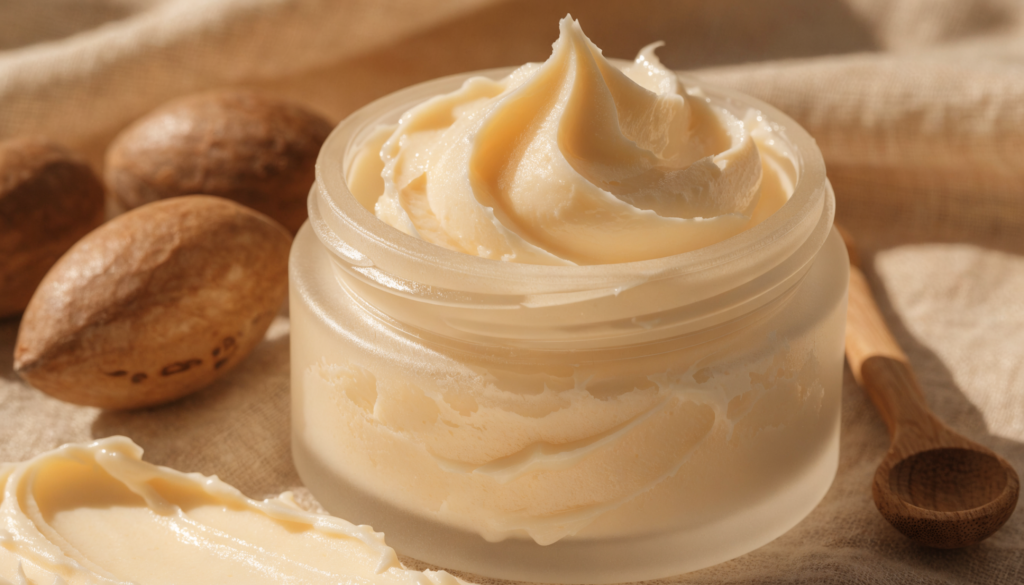
Shea butter is pressed from the kernels of the shea tree, Vitellaria paradoxa, which grows across the dry savannah belt of West Africa. It is naturally rich in oleic and stearic fatty acids, and it carries a notable share of unsaponifiable compounds, which is part of why it feels so cushioning on skin. You can read more about where it comes from in Britannica’s overview of shea butter.
In terms of texture, shea butter is soft and slightly grainy at room temperature. It melts on contact with warm skin, spreads easily, and sinks in without leaving a heavy film behind. Unrefined shea butter carries a mild nutty scent that usually fades within a few minutes.
What Is Cocoa Butter?
Cocoa butter is the fat extracted from cocoa beans, the same beans behind chocolate. It is considerably firmer than shea butter and stays solid until it approaches body temperature, at which point it melts quite sharply. That firmness is precisely what makes it useful: it forms a more occlusive layer that slows water loss from the skin surface.
Cocoa butter also has a higher proportion of saturated fatty acids, and unrefined versions carry a warm chocolate aroma. Refined cocoa butter is close to odourless. In the shea butter vs cocoa butter question, scent alone is often what settles it.
Shea Butter vs Cocoa Butter: The Key Differences
Put shea butter vs cocoa butter side by side and four practical differences stand out.
- Texture and absorption: shea is softer and absorbs faster; cocoa is harder and lingers on the surface longer.
- Barrier effect: cocoa butter is more occlusive, which suits stubbornly dry areas such as elbows, knees, and heels.
- Feel: shea butter feels creamy and breathable, while cocoa butter feels richer and slightly waxier.
- Scent: unrefined shea smells faintly nutty; unrefined cocoa smells clearly of chocolate.
Neither ingredient is a complete routine on its own. Many well-formulated body butters use both, relying on shea for slip and comfort and on cocoa for staying power.
How to Choose Between Them for Your Skin
For everyday use, shea butter vs cocoa butter usually comes down to how much weight you want on your skin. If your skin is normal to dry and you want something you can apply in the morning without feeling coated, shea is the easier pick. If you are dealing with rough, flaky patches that keep coming back, the heavier cushion of cocoa tends to hold up better overnight.
Climate matters too. Through a dry Jordanian summer, a light layer of shea butter after showering is often enough. Once winter arrives and indoor heating pulls moisture out of the air, a richer blend makes more sense. Season by season, the shea butter vs cocoa butter decision is less about which is better and more about how much occlusion your skin needs right now.
Facial skin is a separate conversation. Both butters are best kept to the body for most people, and it is always worth patch testing a new product on a small area before you commit to it.
Quality and Price: The Askim Approach
Askim is a Jordanian brand, and our premise is simple: good body care should not require an import budget. Our shea range and our wider body butter collection are made locally, which keeps the price sensible without thinning out what goes into the jar. Whichever side of shea butter vs cocoa butter you land on, the formula should be worth the money.
Local production also lets us be direct about what is inside. When customers ask us about shea butter vs cocoa butter, we point them to the ingredient list and the texture rather than to marketing language, because the right choice is the one your own skin agrees with.
Frequently Asked Questions
Can I use shea butter and cocoa butter together?
Yes. Shea butter vs cocoa butter is not an either-or choice: applying shea first and adding cocoa over the driest areas is a common approach, and many finished body butters already blend the two in one jar.
Which absorbs faster, shea butter or cocoa butter?
Shea butter absorbs faster. In any shea butter vs cocoa butter comparison, cocoa consistently sits on the skin longer because it is a firmer, more occlusive fat.
Does cocoa butter suit every skin type?
Cocoa butter is heavier than shea, and some people find it too rich for facial skin. On the body it is rarely an issue. If your skin is easily congested, test a small area first and see how it settles.